
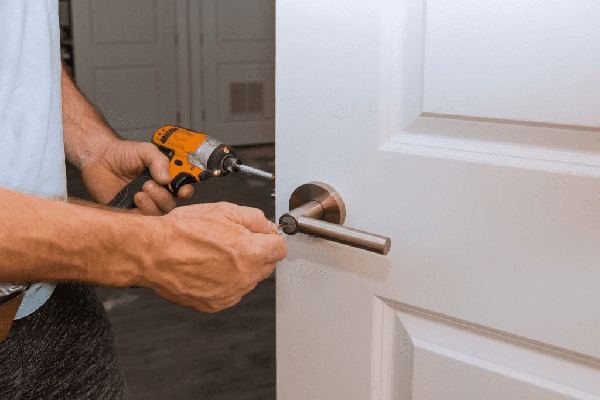
A lock that sticks, wobbles or refuses to latch rarely fails all at once. It gives you warnings for weeks. Catching the problem early usually means a small repair instead of a new lock, or worse, a lockout.
This guide covers what we look at on every lock repair call in Jacksonville, and what you can check yourself before you call anyone.
Start with the simplest test
Before you blame the lock, open the door and try it:
- With the door open, turn the key or thumb-turn so the deadbolt goes out and back.
- Turn the knob or lever and watch the latch.
If everything works smoothly with the door open, your lock is probably fine. The door has shifted, and the bolt or latch is rubbing on the strike plate. That's a door adjustment.
If it's stiff or rough even with the door open, the problem is inside the lock.
This one test separates the two most common problems we see. In Jacksonville's humidity, wooden doors and frames swell in the summer and shrink in the winter, so a lock that works in January can bind in July. We cover that in detail in why door locks stick in Florida humidity.
Common lock problems and what causes them
The key is hard to turn
- Dirt, sand or old grease inside the cylinder. Common near Jacksonville Beach and on doors that face the weather.
- A worn key. Try your spare. If the spare works better, the old key has worn down. Get new copies made from the spare, not from the worn key.
- Worn pins inside a lock that's been used thousands of times.
- Corrosion from salt air or water getting into the cylinder.
The key won't go in at all
Something is blocking the keyway, the pins are corroded, or part of an old key broke off inside. Don't force it. Forcing a key can snap it off, and extracting a broken key is harder when it's jammed deep.
The knob or lever is loose or wobbly
Usually loose mounting screws. You can often tighten them yourself. If it keeps loosening or the handle droops, an internal spring is worn and the lock may need parts or replacing.
The latch doesn't catch
The door closes but won't stay shut. The latch isn't lining up with the hole in the strike plate. Check for sagging hinges first; a loose top hinge is the most common cause.
The deadbolt won't go all the way out
If you have to push or pull the door to make the deadbolt lock, the hole in the frame is out of line or too shallow. A deadbolt that doesn't fully extend is a security problem, not just an annoyance.
The cylinder spins with the key
The lock's internal parts have failed or been tampered with. Call a locksmith.
Check for signs of forced entry
If your lock suddenly stopped working, look closely at it and the frame:
- Fresh scratches around the keyhole.
- A cylinder that's pulled out, twisted or loose.
- Splintered wood around the strike plate.
- A door that doesn't close the way it used to.
If you see any of these, someone may have tried to get in. Call the Jacksonville Sheriff's Office non-emergency line to make a report if you think it's recent, then have the lock replaced, not repaired. A lock that's been attacked can't be trusted, and the frame around it often needs strengthening too. See door reinforcement.
Repair or replace?
| Situation | Usually |
|---|---|
| Door is out of line, lock works with door open | Adjust door or strike |
| Dirty or stiff cylinder, good-quality lock | Clean, lubricate, repin |
| Worn key, lock still good | Cut new keys from the spare, or rekey |
| Loose handle, springs intact | Tighten and adjust |
| Heavy rust or salt damage | Replace, with a better finish |
| Damaged in a break-in | Replace and reinforce the frame |
| Low-grade lock on an outside door | Replace with Grade 1 or 2 |
| Old mortise lock in a historic home | Often worth restoring |
Replacement parts matter. A low-quality cylinder or a no-name lockset can fail again within a year. When we replace, we use trusted brands and match the finish and the key to your other locks where we can. If you need new hardware, see lock change and replacement.
What you can do yourself
Safe, simple fixes most homeowners can handle:
- Tighten screws on the handle, the strike plate and the hinges.
- Lubricate the cylinder with dry graphite or a lock lubricant. Skip household oils; they attract grit.
- Lift a sagging door by replacing one short screw in the top hinge with a three-inch screw that reaches the wall framing.
- Clean the strike plate and the latch of paint drips or debris.
Call a locksmith when:
- A key breaks off in the lock.
- The cylinder spins or the lock is jammed shut.
- You have a mortise lock, a high-security lock or a smart lock that's misbehaving.
- The lock was damaged in a break-in attempt.
- You've tried the basics and it still sticks.
Local lock problems we see in Jacksonville
- Historic homes in San Marco, Riverside, Avondale and Springfield often have mortise locks from the early 1900s. Many can be restored with the right parts, which keeps the original look.
- Beach homes east of the Intracoastal have more corrosion. Plated finishes pit, and cylinders seize. Solid brass and stainless hardware last longer.
- Concrete block homes in Mandarin and the Westside often have wood door frames anchored to masonry. When the frame shifts, the strike plate needs to move with it.
- New builds in Nocatee and Bartram Park sometimes have builder-grade locks that loosen within the first couple of years.
A simple maintenance routine
Twice a year is enough for most homes. An easy way to remember: do it at the start and end of hurricane season, in June and November.
- Lubricate each outside lock.
- Tighten handle and hinge screws.
- Test the deadbolt with the door open and closed.
- Check the finish for rust, especially near the coast.
Get your lock looked at
If a lock is sticking, loose or not latching, we can usually fix it in one visit. You get the full price on the phone before we drive out, and we confirm it before any work starts. Learn more on our door lock repair page, or call (904) 509-0907 or text us a photo of the lock. We're available Mon & Fri 7 AM–2 PM and Tue & Thu 7 AM–6 PM.