
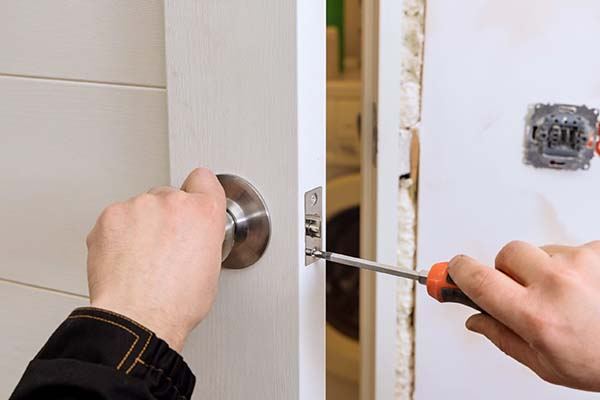
Every summer we get the same call: "My lock is broken. The key barely turns." And every summer, a lot of those locks turn out to be fine. The door is the problem.
Jacksonville's humidity is hard on wooden doors and frames. Here's how to tell what's going on with yours, and how to fix it so it stays fixed.
Why humidity makes locks stick
Wood takes on moisture from the air and swells. It gives it back and shrinks when the air is dry. In Jacksonville, that means doors and frames change size a little with the seasons: bigger and tighter in the humid months from late spring through early fall, and smaller in the drier winter.
A deadbolt or latch only has a little room to spare. When the door swells or the frame shifts even a small amount, the bolt starts rubbing on the edge of the strike plate. You feel that as a lock that's hard to turn. Many homeowners assume the lock is failing and replace it. Then the new lock sticks too, because nothing changed about the door.
We call this the Florida swell.
The 30-second test
Before you do anything else:
- Open the door.
- Turn the key, or the thumb-turn, so the deadbolt goes all the way out and back.
- Turn the knob or lever and let the latch snap back.
If everything moves smoothly with the door open, the lock is fine. The door or frame is out of line. Keep reading.
If it's stiff or gritty even with the door open, the problem is in the lock itself. Skip ahead to "When it really is the lock."
Other signs it's the door
- The lock works fine in winter and sticks in summer.
- It's easier to lock if you push or pull on the door.
- The door rubs the frame at the top corner on the latch side.
- There's a shiny wear mark on the strike plate or the bolt.
- The gap around the door is wider at the bottom than the top.
Fixes that last
1. Tighten the hinges
A sagging door is the most common cause. Tighten every hinge screw. If the top hinge screws spin, replace one with a three-inch screw that reaches the wall framing behind the jamb. That pulls the door back up and often fixes the problem by itself.
2. Adjust the strike plate
If the bolt is hitting the top or bottom edge of the strike plate, the hole needs to move slightly. Small adjustments can be made by filing the edge of the strike opening. Bigger ones mean moving the strike plate and filling the old screw holes. A locksmith can do this in a short visit, and we check the alignment in both directions so it works in winter too.
3. Seal the door
Doors swell most through unsealed wood. The top and bottom edges of many wooden doors were never painted, because nobody sees them. Sealing all six sides with paint or a clear sealer slows how fast the wood takes on moisture. If a door was ever trimmed or planed, seal that bare edge.
4. Check the weatherstrip
New, thick weatherstripping can push a door against the latch side of the frame. If the problem started after new weatherstrip went on, it may be too thick.
5. Plane the door only if you have to
Planing a door that sticks in August can leave a gap in January. We only trim a door when the other fixes aren't enough, and we seal the edge afterward.
When it really is the lock
If the lock sticks even with the door open, it's the lock. Common causes in Jacksonville:
- Dirt and pollen packed into the cylinder.
- Old oil that has turned gummy in the heat.
- Salt corrosion. East of the Intracoastal, salt air gets into cylinders. Plated finishes pit, and pins seize.
- A worn key. Try your spare. If it works better, cut new keys from the spare.
For a stiff cylinder, a puff of dry graphite or lock lubricant helps. Skip oily sprays; they collect grit and can make things worse over time. If that doesn't fix it, the lock may need cleaning and repinning, or replacing.
For more on diagnosing lock problems, see our door lock repair guide.
Doors that have it worst
- Historic wooden doors in San Marco, Riverside, Avondale and Springfield. Solid wood and older frames move the most. Many have original mortise locks that are worth keeping.
- Beach homes. Humidity plus salt is the hardest combination on both doors and hardware. See our high-security locks page for finishes that hold up near the ocean.
- Doors that face the afternoon sun or driving rain, especially on the west and south sides of a house.
- Fiberglass and steel doors swell much less, but their wooden frames still move. If you have one and it sticks, look at the hinges and strike first.
Sliding doors and French doors
Humidity affects more than front doors:
- Sliding glass doors don't swell much, but sand, pollen and grit in the bottom track make them hard to close, and a door that doesn't close fully won't latch. Vacuum the track, and have worn rollers replaced. At Jacksonville Beach, the rollers and latch can wear out within a few years.
- French doors have two doors meeting in the middle, so a small amount of swelling on either one can stop the bolts at the top and bottom from lining up. Adjusting the hinges and the flush bolts usually fixes it.
- Garage entry doors often go unpainted on the garage side. Sealing that face helps keep them from swelling in a hot, damp garage.
Don't fight the lock
Forcing a sticky lock is how keys snap off inside the cylinder. If you have to lean on the door or wiggle the key hard, stop and fix the cause. A broken key in a front door on a Sunday evening is a much bigger problem than a sticky one on a Tuesday.
If the frame is damaged
Sometimes a door that won't line up has a bigger problem: a split jamb, loose strike or rotted wood from years of rain. That's also a security issue, because a weak frame gives way to a kick. See door reinforcement for how we strengthen frames.
What a repair costs
Adjusting a door and strike is usually a short visit, and much less than a new lock. We quote on the phone first. You get the full price on the phone before we drive out, and we confirm it before any work starts.
Get it fixed
Locks sticking in the heat? Call (904) 509-0907 or text us a short video of the lock. We're available Mon & Fri 7 AM–2 PM and Tue & Thu 7 AM–6 PM across Jacksonville. Learn more on our door lock repair page.